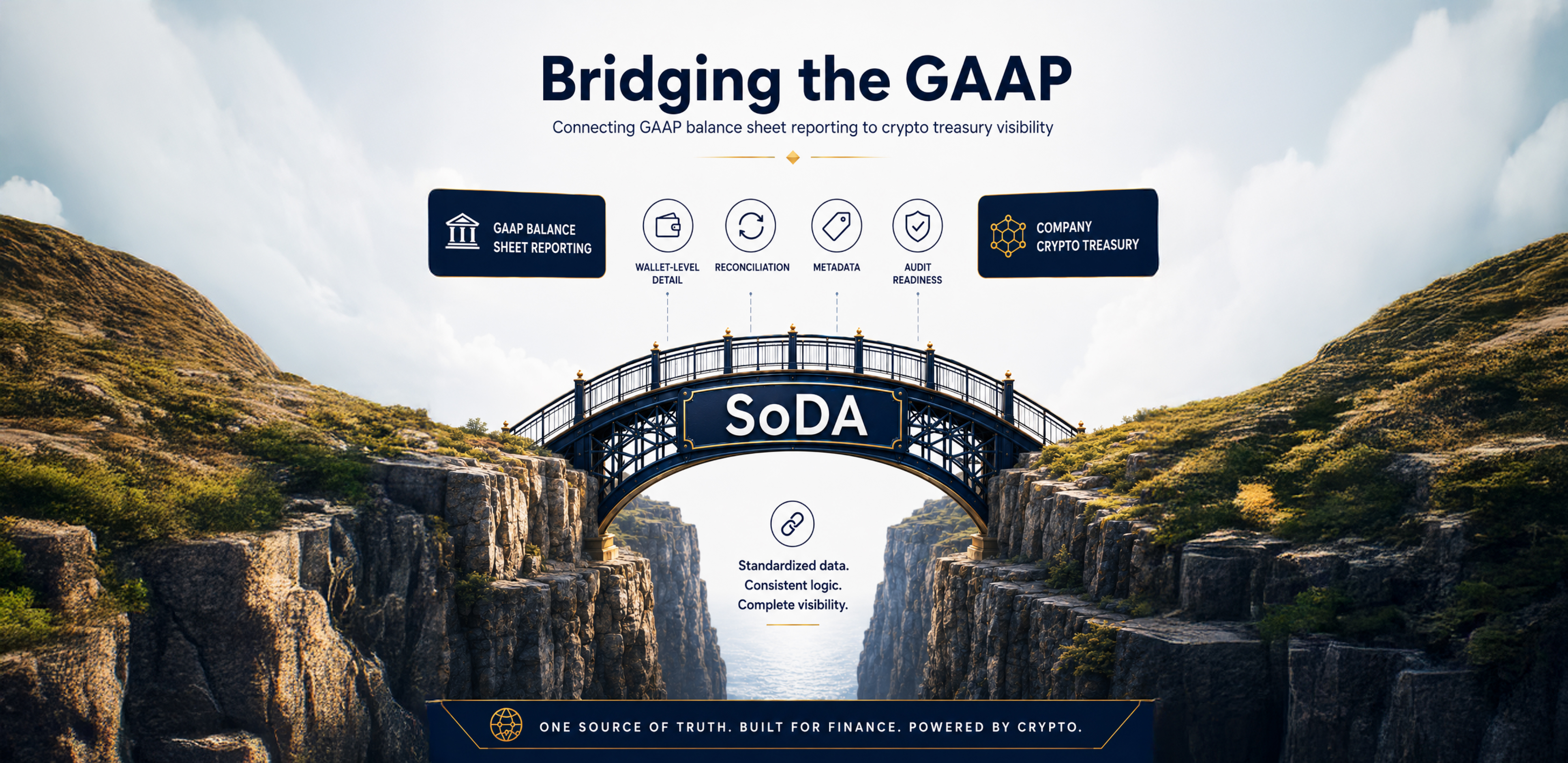
The Statement of Digital Assets (SoDA): A Best Practice for Digital Asset Reporting


Why A Balance Sheet Can Be Technically Correct and Still Fail To Tell The Story Of Your Treasury
A balance sheet has one job that matters more than the rest: telling the reader what a business actually has to work with. For companies holding meaningful digital assets, it has quietly stopped doing that job, not because anyone is doing the accounting wrong, but because the accounting can be done correctly and still leave the people running the business staring at a number that doesn't reflect their understanding of the project’s crypto treasury.
I learned this in real time. Several years ago I was supporting the finance function of a Layer 2 blockchain project, the kind of engagement where the transaction volume would overwhelm any spreadsheet within months of launch.
Every week, we delivered a flash report to leadership:
- Wallet
- Asset (ETH in this case)
- Quantity
- Price
- Fair market value
Everyone in the room worked from the same picture of the treasury. It was one of the few rituals in a chaotic operating environment that felt genuinely solid.
Then came our first GAAP close. The USD value of the ETH on the balance sheet was roughly a third of what we had been reporting every week. Nothing had been lost, sold, hacked, or misplaced. The wallets held the exact quantity that the flash reports said they held. The accountants understood immediately: under the rules at the time, crypto assets like ETH were carried at the lower of cost or impaired value, so the balance sheet was doing precisely what GAAP asked of it. Leadership did not have that context, and their first question was the obvious one:
Where did two-thirds of our treasury go?
What stayed with me from that close wasn't the accounting mechanics. It was that nobody in the room was wrong. The accountants followed the standard. Leadership asked a completely reasonable question. The reporting language simply could not carry the information both sides needed. And when your reporting language fails, the burden of translation lands on the operator: in the board meeting, in the diligence call, in the conversation with the auditor. That translation work is what this article is about and what led to the creation of a best practice called the Statement of Digital Assets, which was codified in a whitepaper (www.sodafinance.xyz).
What The Balance Sheet Is Allowed To Say
Most operators carry an assumption they've never had reason to examine: if the financials are GAAP-compliant, the company's finances are understood. It's a fair assumption in most industries. In this one, it breaks down, because what GAAP asks the balance sheet to report about digital assets and what an operator, board member, or investor needs to know about those assets are two different things.
Start with the mechanic that produced my one-third problem. For years, digital assets were generally classified as indefinite-lived intangible assets and carried at the lower of cost or market value "LOCOM" if you want the shorthand. In plain English: the asset goes on the books at what you paid for it, gets marked down if the price falls, and never gets marked back up when the price recovers. The number can only shrink. That treatment is reasonable for the intangibles it was designed for. Applied to a volatile, liquid, exchange-traded asset, it produces balance sheets where a treasury that has tripled in value shows up smaller than the day it was acquired.(1)
In December 2023, FASB issued Accounting Standards Update 2023-08, and credit where due, it was real progress. Qualifying crypto assets are now measured at fair value, with changes flowing through net income each period.(2) For a treasury of ETH or bitcoin, the balance sheet finally moves with reality.
But look at the qualifying criteria, because the exclusions are where crypto-native businesses actually live. To get fair value treatment, an asset must be fungible, must not give the holder enforceable rights to or claims on underlying goods, services, or other assets, and here's the big one: must not be created or issued by the reporting entity or its related parties, among other requirements. That last criterion excludes native tokens: the token your own project issued. It's joined on the exclusion list by NFTs and wrapped tokens, all of which remain at lower of cost or impaired value.
Think about what that means for a protocol whose treasury is dominated by its own token, which describes a large share of the businesses in this industry. The asset that most defines their financial position sits on the balance sheet at a de minimis value (accounting-speak for next to nothing) regardless of what it trades for on any exchange.(1) The fair value reporting revolution skipped them.
Then there are stablecoins, which function much like cash in day-to-day operations: companies use them to pay vendors, reserve for taxes, and manage runway. Yet under current GAAP treatment, they generally do not qualify as cash or cash equivalents on the balance sheet. Their relative price stability also means they typically create far less exposure to capital gains and losses than more volatile digital assets, further distinguishing them from assets accounted for under LOCOM or fair value.
So a single "Digital Assets" account nested in the “Other Assets” section of a balance sheet can simultaneously contain assets marked to
- Fair value,
- Lower of cost or market,
- and stablecoins that are almost-but-not-cash.
The white paper I helped author calls this comparing apples to oranges to bananas.(1) One line item, three distinct values, and no way for the reader to tell which is which. To be careful here: none of this is a criticism of GAAP or the people applying it. It's an observation that the reporting framework hasn't caught up to the asset class, and the people paying for the lag are the ones who have to explain the numbers.
"The white paper I helped author calls this comparing apples to oranges to bananas."
A Schedule, Not A Standard
The fix, in my view, is not new GAAP. Standard-setting moves at standard-setting speed, and operators need something that works this quarter. The fix is a supporting schedule, the same move finance teams have always made when a summary number needs a build behind it.
That's what the Statement of Digital Assets is. SoDA is a standardized report that sits alongside the financial statements and shows, for every combination of wallet and asset the organization touches, what is held, where it's held, what it's for, and what it's worth at both book value and fair market value, tying back to the balance sheet Digital Assets entry.(1) It is deliberately unglamorous. It is not a proprietary product, not a replacement for GAAP, and not a novel financial expression; the white paper says as much, hand the same problem to a group of crypto finance professionals independently and they'd each land somewhere materially similar.(1) SoDA was developed as a public-benefit collaboration with contributions from practitioners across funds, protocols, and accounting firms open-sourcing a format that had already proven itself inside real companies, so the industry could standardize on it rather than each team reinventing it badly.(1)
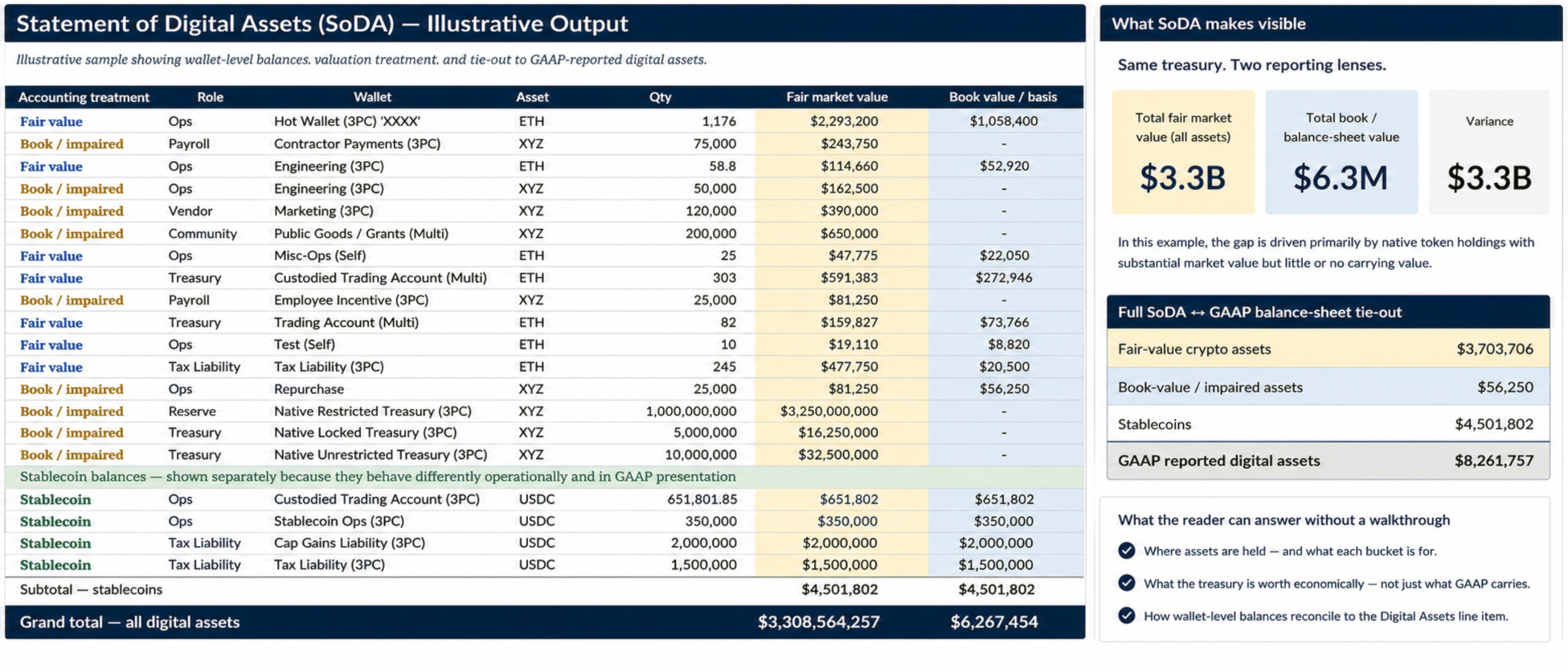
The structure rests on a few primitives. A ‘wallet’ is a human-readable label tied to an address or a custodian account. An ‘asset’ is the token, fungible or an NFT. The ‘wallet/asset pair’ is the atomic unit: there can be only one unique asset per wallet. And a ‘role’ is a tag the business assigns to each pair describing what it's for: operations, yield, tax reserve, restricted grants, native treasury.(1) A single row of the finished statement reads simply: this wallet, holding this asset, this many units, tagged with this role, worth this much at fair market value, carried at that much on the books. Roles are what turn that list of balances into a story. Roll the pairs up by role and you can see, at a glance, what portion of the treasury is available to run the business, what's locked or spoken for, what's reserved against liabilities and how much of the whole thing is the company's own token.
Getting there requires the whole reporting pipeline to function, and it's worth naming each link because SoDA is the connective tissue between them, not a substitute for any of them. It starts with the wallets themselves and basic wallet hygiene, knowing every wallet the organization controls and what each is used for. On-chain activity then flows into a digital asset subledger, software that aggregates transactions across chains and wallets, tracks cost basis, and translates activity into journal entries.(1) The subledger feeds the general ledger, which produces the financial statements. SoDA draws from the subledger and the general ledger to present the full build and reconcile it to the balance sheet.(1) Not incidentally, it's also the build an auditor needs: a company that can reconcile its on-chain balances this way has, by the evidence of that effort, developed internal processes rigorous enough to be tested.(1)
A fair question at this point: doesn't the subledger already do this? It's the input, not the statement. A subledger aggregates and prices transactions; it doesn't assign business roles, doesn't distinguish restricted from unrestricted, doesn't flag what's staked or loaned out, and doesn't present a standardized tie-out a board member or investor can read without a walkthrough. The value of SoDA is the presentation layer, the same reason raw transaction data never made financial statements redundant.
Where Operators Actually Get Hurt
The one-third surprise is the dramatic version of the problem. The chronic challenges of crypto accounting are quieter, and in my experience three of them recur across companies of every size.
- Incomplete wallet coverage. Wallets are frictionless to create in a way bank accounts never were, and that's mostly a feature: engineering spins one up for gas, marketing for a campaign, someone for a grant program. That is until the close, when finance discovers assets and activity nobody reported. Every unaccounted wallet is a hole in the balance sheet, a gap in the audit trail, and an operational security question all at once. The discipline of maintaining a SoDA forces the full inventory, because the statement is only credible if it's complete.
- Not realizing when revenue happens. When a business is paid in tokens, revenue is recognized when the goods or services are exchanged measured in fiat-equivalent terms at that moment and that recognition carries tax consequences, whether or not the tokens are ever converted to dollars.(1) I've watched teams treat token revenue as somehow provisional, as if the tax clock wouldn't start until they sold. It doesn't work that way, the income is locked in then and there, and a later sale can be a ‘second’ taxable event, a gain or loss measured against that original basis.(1) The education usually happens at tax time, which is the expensive classroom. This is a P&L issue, but it ultimately impacts the balance sheet.
- Tax reserves left in volatile assets.If you've recognized income and owe tax on it, that liability is fixed in fiat terms. Leaving the reserve in ETH or your native token means you're taking a leveraged position on your own tax bill if the market drops before payment comes due, the shortfall is yours to cover. A USD stablecoin wallet with a tax liability roll within SoDA makes this visible on one page: here is what we owe, here is what's reserved against it, and here is what it's denominated in. When those don't line up, you want to know in month two, not in April.
None of these failures require negligence. They require only that nobody is looking at the treasury through a lens built for it, which, absent a schedule like this, nobody is.
Investors Feel The Gap Too
I said the primary reader of this essay is the operator, and it is. But the pull for this kind of reporting is increasingly coming from the other side of the table. Investors have long asked crypto portfolio companies, informally, for what amounts to a treasury statement: the fair value of everything you hold, liquid and not, with enough detail to judge runway.(1) In my own work, a number of leading crypto funds have gone further and written SoDA-style reporting into their information rights, the contractual reporting requirements attached to their investments. I'll resist putting a number on it, because the honest claim isn't "everyone requires this now." The honest claim is that serious investors have noticed the gap and started closing it in deal terms and that operators who can produce this report before being asked are signaling the kind of financial maturity diligence is designed to find.
There's a precedent for how this goes. The Statement of Cash Flows was not always a pillar of financial reporting. Before FASB mandated it in 1987 through Statement No. 95, companies reported a Statement of Changes in Financial Position, which told readers far less, and cash flow analysis lived in working documents that careful readers assembled themselves.(1) A practical format proved its value in use, spread through practice, and was eventually formalized. I'm not going to predict that SoDA follows the same path on any particular timeline, forward-looking claims about standard-setting are worth exactly what you pay for them. But the shape is familiar: a reporting gap, a working-paper solution, adoption by the people who feel the gap most, and pressure that builds from practice toward standard. If it lands, we'll have an additional financial statement for businesses that hold digital assets. (Most non-accountants would consider this the fourth financial statement, although it would technically be the fifth after the statement of stockholders' equity.)
“Operators who can produce this report before being asked are signaling the kind of financial maturity diligence is designed to find.”
What This Doesn't Solve
I want to be plain about the limits, because overclaiming is how good tools get dismissed. SoDA does not score the quality of the assets it lists; a complete, beautifully reconciled statement can still describe a treasury full of illiquid tokens and bad decisions.(1) Fair market value itself isn't the whole story, a market price times a quantity says nothing about whether the market could absorb a sale, and unrealized gains carry latent tax that quietly discounts what "liquidity" really means.(1) The statement doesn't replace a subledger, doesn't replace an audit, and doesn't replace the judgment of the people reading it. What it does is narrower and, I'd argue, more fundamental: it makes the treasury legible, to everyone who needs to read it, in a format they can compare across companies and across time. Legibility doesn't guarantee good decisions. It's just very hard to make good decisions without it.
Leadership in my story eventually got comfortable with the gap between their balance sheet and their treasury, but only because we built the bridge by hand and walked them across it. That work shouldn't have to be invented separately inside every company that holds digital assets. It's now written down and open for anyone to adopt.
If you're an operator staring at a digital assets line you can't explain to your own board, or an investor who has stopped trusting the ones you're shown, I'd genuinely like to hear about it. Please take a deeper read of the SoDA whitepaper and also feel free to reach out to me directly.
(1): *The Statement of Digital Assets: Bridging GAAP, A New Standard for Reporting On-Chain Assets* (SoDA public benefit collaboration, 2026 update). Referenced here: the executive summary and Section II (balance sheet opacity, book vs. fair market value, the "apples, oranges, bananas" framing, and the definition of FMV as market price times quantity); Section II (SoDA primitives: wallet, asset, wallet/asset pair, role); Section III (SoDA does not score asset quality; liquidity and latent tax caveats); Section IV (origin story, current treatments of digital assets, and the FAS 95 / Statement of Cash Flows history); Section V (investor reporting and information rights; auditability: the reconciliation effort as evidence of controllable internal processes); Section VI (the wallet → subledger → general ledger → SoDA process).
(2): FASB Accounting Standards Update No. 2023-08 (December 2023), *Accounting for and Disclosure of Crypto Assets* (Subtopic 350-60), as summarized in the SoDA white paper, including the qualifying criteria table and the exclusion of native tokens, NFTs, and wrapped tokens from fair value treatment.